Writing a pitch used to take real effort. You read the query, decided if you were actually the right person, and wrote something only you could say. Now AI can produce a hundred pitches in a minute, and almost any journalist’s inbox shows it.
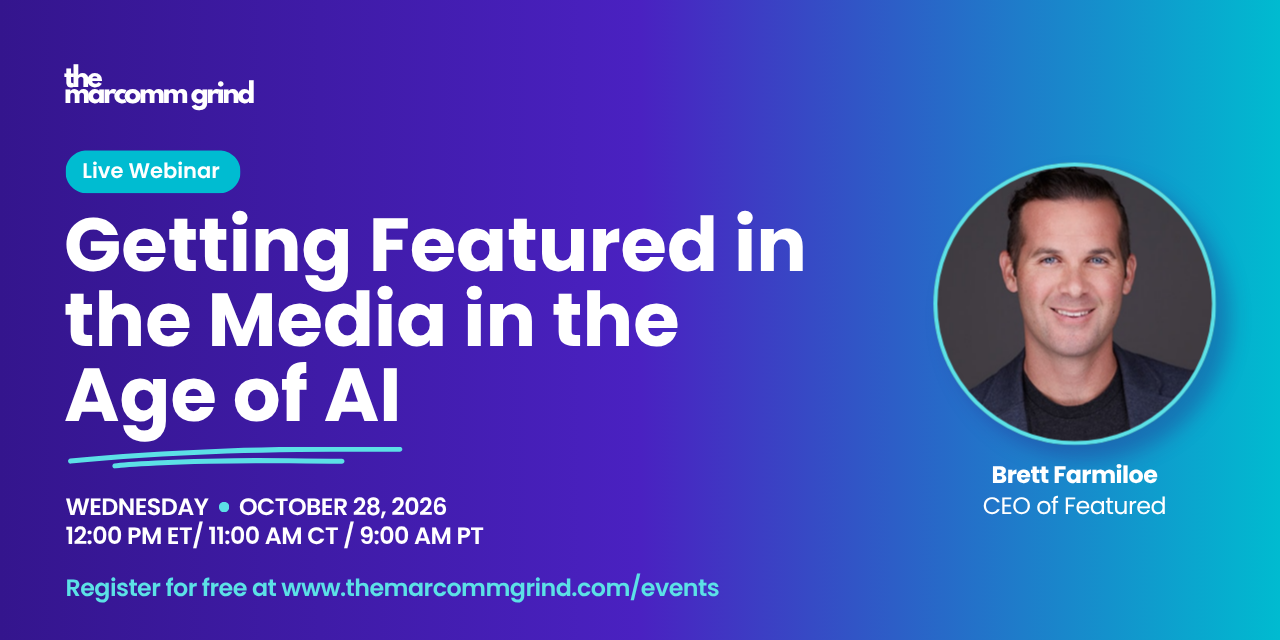
Brett Farmiloe runs Featured, the company that bought HARO and brought it back in 2025. He joined The Marcomm Grind for a Q&A sharing what HARO is today, where the AI line is, what wins in the first ten seconds, and why a quote in a trade publication matters more now that AI assistants are the ones answering questions.
1. For anyone new to HARO or who hasn't used it in a while, what is HARO today, and what's different?
HARO is a free, email newsletter that connects journalists with sources for stories.
For subscribers, HARO is the same product it was in 2008. You subscribe, and three times a day - at 5:35 am, 12:35 pm, and 5:35 pm Eastern - you’ll receive an email from HARO with journalist requests for sources for stories they’re working on.
It is free for both journalists and sources, and is fully supported by newsletter ads.
What changed is who runs it and what sits underneath it. Cision retired the brand a couple of years ago. My company,
Featured, bought it and brought it back in 2025 with one simple goal: restore the quality and trust that makes HARO great.
Basically, that means eliminating spam so that journalists find value in using HARO, and comms pros can confidently pitch journalists using the service. To maintain quality and trust, we do a few things.
- Every journalist request passes through a review before it goes out, and we reject about a third of what gets submitted.
- We mask every reply address, so a reporter's inbox never becomes a list somebody can sell.
- We score every pitch for AI authorship before delivering it. 35% of journalists opt out of receiving AI-generated pitches on HARO, and we honor their request by withholding those pitches. We notify the person who made the pitch, letting them know HARO didn’t deliver the message, and we share steps they can take to resend the pitch.
- Every pitch has community reporting tools, so journalists can report bad actors directly, and those reports get looked at by a person.
The numbers say people came back. Journalist requests are up 68% year over year, and subscribers are up 54%. Pitch volume to journalists has grown 43% over the last 18 months.
Bottom line:
HARO is unique because it’s free and trusted. Being free makes sources more accessible to journalists, which enables them to connect with a wider audience, very fast, at the speed of trust.
2. Your data says 21% of pitches are now fully AI-generated, and human-written pitches are 3x more likely to get featured. Many marketing and comms folks use AI every day as a writing partner. Where's the line between AI helping your pitch and AI hurting it?
What plagues HARO is that some people treat it as a numbers game. They think the more pitches that they make, the more placements they’ll get.
AI enables this line of thinking and makes it easier than ever to generate and send a pitch.
That’s where we draw the line. If there’s no original human thought behind the answer, it’ll get flagged as “AI-generated.”
Does AI detection have false positives? Absolutely. That’s why HARO has humans on our team internally review reports to help police the community.
That said, there’s a lot of policing. We ban a user from HARO every 23 minutes. The reasons vary, but I will say that a high volume of pitches sent is a signal in our systems, as are the number of AI-generated pitches and the percentage of pitches that are AI-generated.
Now, let’s flip it. Here’s what makes HARO hard to use for a busy subject matter expert: time. How are you supposed to monitor HARO three times a day, every day, and find the right query that matches your expertise?
That’s where AI usage shines: when it is used for quality. We see best practices from users who leverage AI for monitoring and to polish an answer before sending.
For example, many users tell us they use HARO on a treadmill in the morning. Their AI monitoring will alert them to a relevant HARO, and then they’ll voice their answer into AI with rough thoughts. Their AI will then polish their pitch and get it ready to copy, edit, and send.
That’s totally fine, and a use case we love to support. It’s pushing out the quantity-focused folks, and doing everything we can to make it as easy as possible to share high-quality insights with journalists. AI is a major part of that enablement.
3. Say you're a freelancer, a job seeker, or a comms team of one; what does a realistic HARO practice look like, and what should you expect in your first month?
HARO is like a faucet of free media opportunities. Turn the faucet on when you need it by opening up your inbox, and turn it off when you don’t by leaving the HARO emails unopened.
The key to success on HARO, especially when you’re balancing so much as a freelancer, job seeker, or comms team of one, is consistency.
To be consistent, the habit I see most from our users is calendaring. What gets calendared, gets done. I see a lot of people calendar a 15-minute block around their favorite HARO edition (morning, afternoon, or evening), and use that time to open and respond to a pitch.
You can also use tools to do HARO monitoring for you and save time. Featured has a
HARO monitoring workflow, and
Connectively allows you to set alerts. Both Featured and Connectively provide early access to HARO queries because we own and operate all three brands, and there’s often a gap between when we approve a HARO query and when that query gets featured in a HARO edition.
Bringing it back:
- Subscribe to HARO at helpareporter.com
- Open a few emails and respond to a few relevant queries to see whether HARO is a good fit.
- If HARO is a fit, decide how you’ll invest. Calendar time? Leverage tools for monitoring?
- Use it as a networking tool. I recommend connecting/following the journalists who use the service on LinkedIn / Substack to build relationships.
- Measure what works. Double down on the stuff that does. Drop the stuff that doesn’t.
For expectations, be pessimistic in month one. A reasonable pace is fifteen to twenty pitches in your first month, and one or two placements coming out of that. Some of those placements will show up two months later, because a reporter files a story and it runs whenever it runs. Almost nobody gets picked up in week one, and a lot of people quit in week two because of that.
The thing that compounds is your material. After a month you will have a small library of your own answers about the four or five topics you actually know. Editing gets faster because you are reusing your own material, and the fifteen minutes stops feeling like a chore. That is the point where it starts working.
For a job seeker specifically, the byline is the asset. Getting quoted in a trade publication in your field is a credential you can put in front of a hiring manager, and it costs you nothing but the time.
4. You've seen over 2 million pitches. When a journalist opens one, what wins in the first ten seconds, and what gets it deleted or banned?
HARO stands for Help a Reporter Out, but the acronym can also be used as a checklist for what works:
Helpful, Authentic, Relevant, On time.
In the first ten seconds a reporter is answering one question, which is whether you are relevant. Relevance can be seen in credentials, and whether they match the query. If a journalist is looking for a CISO at a Fortune 500, and you are a CISO at a Fortune 500, you’re relevant.
On time means that a journalist is on deadline, and they’ll often take the most credible source as fast as possible to move their story forward, and get paid for their work. Submitting quickly is key.
Helpful is just helping the journalist do their job. Give them a number or a real opinion they can attribute to you. One good quote they can lift without editing beats four paragraphs of context they have to mine.
What gets deleted is stuff like answering a query you are not qualified for. Opening with your company's history instead of their question. Attachments. Links to a page where they can learn more. Anything that reads like a template with the reporter's beat pasted into a blank.
What gets you banned is a different category, and it is almost always volume. Blasting every query in every category. Submitting the same block of text over and over. Using someone else's credentials for a quote. Pitching a journalist off-platform after using HARO to get their information, which is the one that makes reporters angriest and the one they report most.
5. Search is changing and AI assistants are answering questions people used to Google. Why does earned media still matter for visibility in 2026, and where do quotes and features show up now?
Earned media matters more than it did, based on what we’re seeing in our data and company growth.
We
recently analyzed 405 GEO audits covering 378 brands, looking at what AI assistants actually cite when somebody asks a buying question in a given category. That produced 22,881 citations across 11,499 domains. Of the citations we could classify, 64.5 percent went to editorial coverage. Brand-owned content accounted for 1.7 percent.
When somebody asks an assistant which vendor they should use, the model is reading articles written by other people.
Two other findings surprised me. The first is that 78.5 percent of the brands we audited were not mentioned once in answers about their own category. The second is that authority matters far less than the SEO world assumes. About 34.5 percent of citations went to sites with a domain authority under 40, and the median cited domain sat at 37. Roughly three quarters of the cited domains appeared exactly once. The trade publication nobody optimizes for having a moment, and the traditional pitch list is being rewritten.
So where do quotes show up now? In the roundup post that gets scraped. In the industry trade nobody thinks is prestigious. In the expert commentary section of an article about your category. In a piece that runs today and gets read by a model six months from now. A quote you place today is training data and retrieval fodder later, which seems weird until you realize that’s how AI is generating answers that it displays to prospective customers.
The practical implication is that the boring old practice got more valuable. Answer queries. Get quoted in specific places. The difference is that you should stop grading placements purely by domain authority, because the assistants clearly do not.